
The Chalk Stones
- Sue Reed

- Dec 29, 2020
- 3 min read
I drove past the car park twice, before I realised I’d actually reached my destination at Cocking Hill. So much for my navigation skills, it didn’t bode well for the next couple of hours.
I’d come in search of the Chalk Stones Trail. A 5 mile network of paths and bridle ways marked by 14 huge rounded stone sculptures, each around 2 meters in diameter. The stones are the work of renowned British artist, Andy Goldsworthy who specialises in using natural materials like stone, twigs, leaves and, even ice. A few years before he created the Chalk Stones, he unceremoniously dumped a whole load of giant snowballs in central London. He’d gathered the snow from his native Scotland, keeping it in cold storage until mid-summer when he delivered it to the City in refrigerated lorries. Bemused residents awoke to the site of snow on the pavements in June. It was perhaps this, that inspired the Chalk Stones.
The chalk he used in his sculptures was excavated from a local quarry, just a few miles away from the trail in the heart of the South Downs. Goldsworthy was intrigued by the material that emerged. ‘The earth was white, and wet,’ he said, ‘which was like finding the sky in the ground.’[1] A fellow walker I met, told me he remembered when the stones were first installed in 2002. The brightness was startling, he said. ‘It looked alien and out of place on the green of the Downs.’
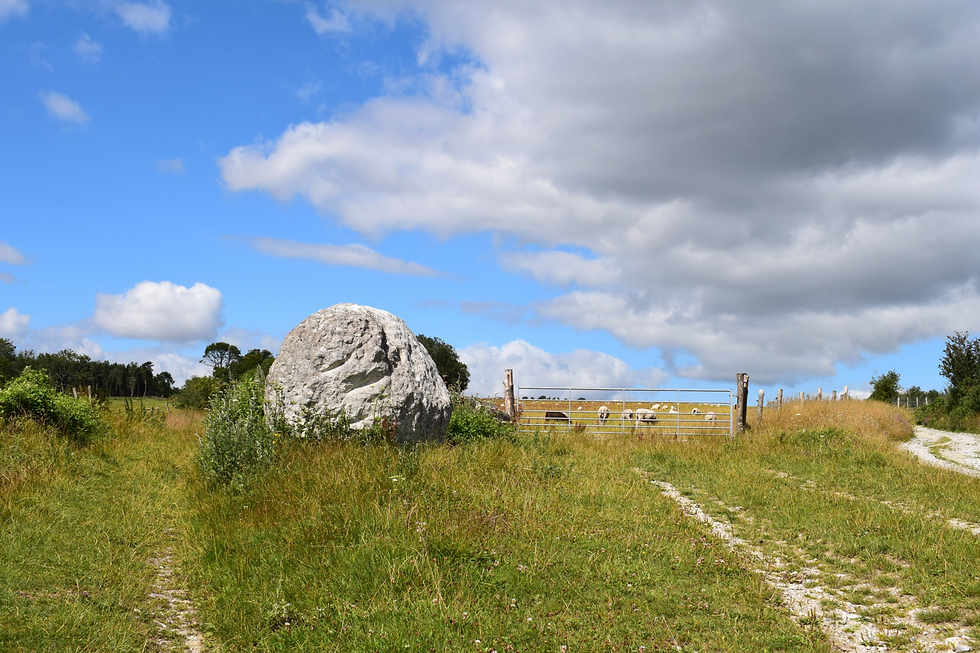
As I came up the hill and saw the first stone, I could see what he meant. Although no longer white, it was a strange contrast with the pastoral scene of rolling grassland and sheep happily grazing in the background. My first thoughts were that it looked like the remnants of an ancient henge, sited on the ridge that runs along the South Downs. Then as I walked round it, I could see how it echoed the hill beyond.
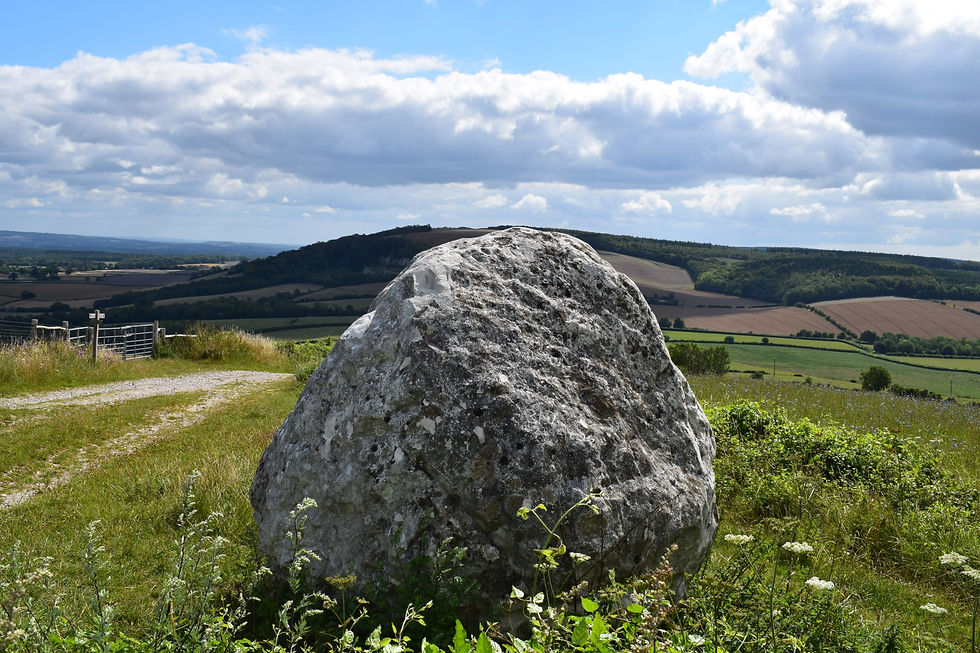
The stones are not simply way markers on the trail. Goldsworthy carefully sited each one. The question is why? Were they framing a view? Or maybe as a man made intervention into the gloom of a woodland, or perhaps, an exclamation point in a sunny glade? Much of Goldsworthy’s ethos is bound up in using local materials and the stones certainly reference the chalk just below the surface.

Goldsworthy’s work is frequently transitory and ephemeral and, in line with the early land artists of the sixties, he’s interested in the process of decay. His sculpting of the chalk, hacking and smoothing to create rounded surfaces mirrors nature’s weathering process. ‘It's not about art,” he has explained. ‘It's just about life and the need to understand that a lot of things in life do not last.’[2] Interestingly, when the pieces were installed, Goldsworthy thought they might last for two years but a study by the University of Sussex in 2012 estimated that it was more likely to be two hundred years.[3] Eighteen years on and deep fissures have formed and pieces started to break away. Chalk is particularly susceptible to water and the winter rains have caused pitting and small craters that look like the surface of the moon. The stones are scattered with mosses and lichens and are no longer white but have taken on a rough, silver grey patina.

In some places they have become submerged by the undergrowth, almost as if they’ve been absorbed back into the earth.

As I trekked through the larch plantations dotted on the southern slopes of the Downs and meandered through beech and hazel woodlands, I mused that it was a good job I was walking alone and that there was no one to witness my excitement as I came upon each of the stones. Nor the strange ritual dance I did, slowly circling each piece, puzzling to understand its placement.
For those of you who decide to follow this trail, I can offer two pieces of practical advice. The first is to invest in a good OS map, as the trail leaflet I downloaded is not entirely clear. The second is to carry a large bar of chocolate to console yourself when you have to retrace your steps for the third time!
[1] Oliver Lowenstein, ‘Natural Time and Human Experience: Andy Goldsworthy's Dialogue with Modernity’, Sculpture, 22, 5 (2003) [2]‘Andy Goldsworthy’, in artnet <http://www.artnet.com/artists/andy-goldsworthy/> [accessed 29 July 2020]. [3] Moses, Cherith and Williams, Rendel, ‘Weathering and durability of the Goldsworthy Chalk Stones, South Downs, West Sussex, England’, Environmental Geology, 56 (2008), 495-506.


Comments